How to Treat Nail Fungus: Options That Actually Work
Nail fungus can make a toenail or fingernail become thick, discoloured, brittle, distorted, or separated from the skin underneath. It can be frustrating to treat, and visible improvement is usually slow.
Advertisements frequently promise that one daily ritual will eliminate fungus permanently by addressing its “root cause.” That language hides an important fact: not every abnormal-looking nail is caused by fungus, and no treatment guarantees that an infection will never return.
Nail fungus is treatable. Effective management begins with confirming the diagnosis, determining how much of the nail is affected, choosing an appropriate antifungal treatment, and reducing the risk of reinfection.
What is nail fungus?
The medical term for a fungal nail infection is onychomycosis.
It may be caused by:
- Dermatophytes, which also cause athlete’s foot
- Yeasts
- Other types of fungi
Toenails are affected more frequently than fingernails because feet often spend long periods inside warm, enclosed footwear. Toenails also grow more slowly and may receive less blood circulation than fingernails.
The CDC notes that onychomycosis can be caused by dermatophytes, yeasts, or other fungi. CDC clinical overview
What does nail fungus look like?
Possible signs include:
- White, yellow, brown, or cloudy discoloration
- Thickened nail tissue
- A nail that crumbles or breaks easily
- Debris beneath the nail
- Separation of the nail from the nail bed
- Distorted nail shape
- An unpleasant smell
- Discomfort when wearing shoes
- Spread to other nails
The infection may begin at the outer edge of the nail and move inward. In other cases, changes start on the surface or near the base.
The American Academy of Dermatology states that fungal nail infections can cause nails to thicken, change colour, lift, and crumble. American Academy of Dermatology
Is every yellow or thickened nail fungal?
No. This is one of the most important points missing from miracle-treatment advertisements.
Several conditions can resemble nail fungus, including:
- Nail psoriasis
- Injury or repeated pressure from shoes
- Age-related nail thickening
- Bacterial infection
- Eczema
- Lichen planus
- Poor circulation
- A growth beneath the nail
- Nail changes caused by medication
- Rarely, skin cancer affecting the nail area
Using antifungal treatment on a non-fungal nail wastes time and can delay the correct diagnosis.
For this reason, the American Academy of Dermatology advises against prescribing oral antifungal medicine for suspected nail fungus without confirming the fungal infection. AAD clinical recommendation
How is nail fungus diagnosed?
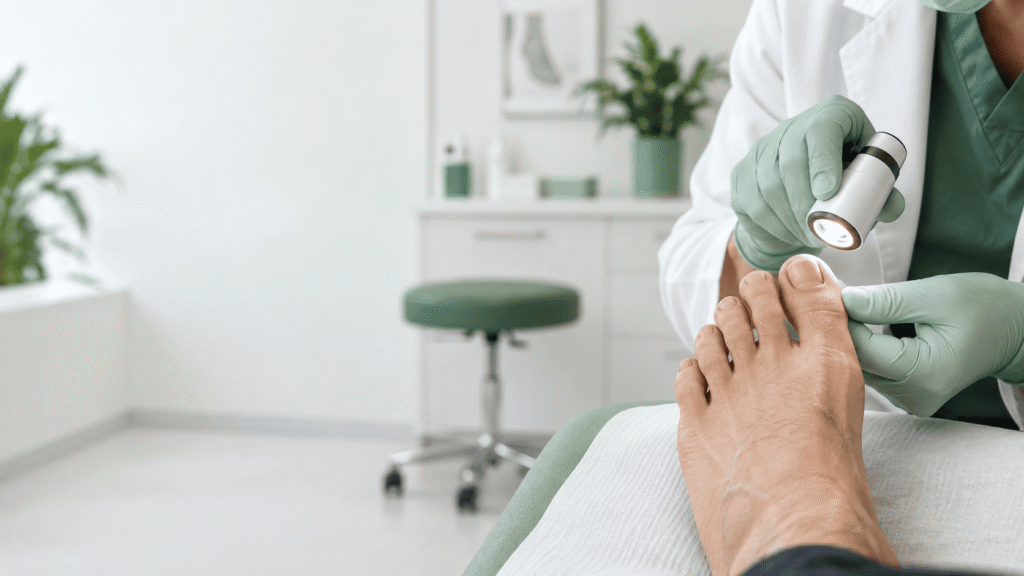
A dermatologist, podiatrist, or other qualified healthcare professional will examine the affected nails and surrounding skin.
Because appearance alone may be misleading, the clinician may collect:
- Nail clippings
- Debris from underneath the nail
- A small scraping
- Occasionally, another type of sample
Laboratory testing can look for fungal organisms and may help identify the type involved.
Testing is particularly important before oral treatment because these medicines have potential adverse effects and should not be used unnecessarily.
Does nail fungus have one “root cause”?
No single root cause explains every infection.
Fungi need an opportunity to reach the nail. Small cracks, nail trauma, athlete’s foot, moisture, and repeated exposure can all contribute.
Risk factors include:
- Increasing age
- Athlete’s foot
- Sweaty feet
- Frequently wearing enclosed shoes
- Walking barefoot in shared wet areas
- Nail injury
- Poor circulation
- Diabetes
- A weakened immune system
- Sharing nail tools
- Previous fungal nail infection
- A family history of fungal infections
A treatment can remove an infection without eliminating every future exposure. This is why recurrence is possible even after successful treatment.
Can nail fungus be cured?
Yes, many fungal nail infections can be treated successfully. However, success depends on factors such as:
- The organism causing the infection
- How many nails are involved
- How much of each nail is affected
- Whether the nail matrix is involved
- The treatment selected
- Consistency of use
- Nail-growth speed
- Underlying health conditions
- Reinfection from untreated athlete’s foot or contaminated footwear
Treatment may eliminate the fungus before the nail looks normal. The damaged portion must then grow out.
Toenails grow slowly, so visual recovery can take approximately a year or longer. A nail that still appears discoloured after several weeks does not necessarily mean treatment has failed.
Topical antifungal treatments
Topical treatments are applied directly to the nail. Depending on the country and product, they may be supplied as a solution, lacquer, or medicated preparation.
A clinician may consider topical treatment when:
- The infection is mild
- Only a limited portion of the nail is involved
- Few nails are affected
- The infection does not deeply involve the nail matrix
- Oral medicine is unsuitable
- The patient prefers to avoid systemic treatment
Topical medicines generally require consistent application for many months. Some need to be applied daily; others follow a different schedule.
Their main limitation is penetration. A thick nail plate can make it difficult for medicine to reach the infected tissue underneath.
A healthcare professional may recommend trimming, filing, or carefully thinning the nail to improve treatment access. This should be done safely, especially for people with diabetes, nerve damage, or poor circulation.
Oral antifungal treatment
Oral antifungal medicine reaches the nail through the bloodstream and is often more effective than topical treatment for moderate or extensive infection.
Commonly used prescription options may include:
- Terbinafine
- Itraconazole
- Other antifungal medicines selected for particular circumstances
Terbinafine is frequently used for dermatophyte toenail infections. Treatment courses vary according to the nail involved, the diagnosis, medical history, and local guidelines.
The American Academy of Dermatology explains that terbinafine may be prescribed for approximately six weeks for fingernails and 12 weeks for toenails. Even after treatment clears the infection, the nail can take a year or longer to grow out completely. AAD treatment guidance
Oral treatment is not suitable for everyone. Considerations include:
- Liver disease
- Medication interactions
- Pregnancy or breastfeeding
- Age
- Other medical conditions
- The type of fungus
- Previous treatment response
Blood testing may be recommended before or during treatment. Do not buy prescription antifungal tablets from an unverified source or take someone else’s medication.
Combination treatment
In some cases, a clinician may combine approaches, such as:
- Oral and topical antifungal treatment
- Medication with professional nail reduction
- Treatment of athlete’s foot at the same time
- Removal of severely damaged nail material
- Preventive care after the main treatment ends
Combination treatment is not automatically necessary. It should be based on the severity and type of infection.
Can the infected nail be removed?
Partial or complete nail removal may be considered in selected cases, particularly when a nail is painful, severely thickened, extensively damaged, or not responding to other approaches.
Removal alone may not eliminate the infection because fungus can remain in the nail bed or surrounding tissue. A clinician may combine removal with antifungal treatment.
Nail removal should not be attempted at home.
Does laser treatment cure nail fungus?
Laser and light-based treatments are marketed widely, but consumers should distinguish between:
- Temporary improvement in nail appearance
- An increase in clear-looking nail
- Laboratory-confirmed elimination of infection
- A complete clinical cure
These outcomes are not interchangeable.
The FDA has stated that devices promoted specifically for treating fungal nail infection require evidence of an antifungal effect—not merely an improvement in how the nail looks.
Ask the provider:
- Is the device cleared for temporary clear-nail improvement or for treating infection?
- What were the complete cure rates?
- Was fungal testing performed?
- How many sessions are required?
- What is the total cost?
- How often does the infection return?
- Is medication also needed?
Laser treatment should not be presented as a guaranteed permanent cure.
Do home remedies work?
Popular home remedies include:
- Vinegar
- Tea tree oil
- Baking soda
- Hydrogen peroxide
- Essential oils
- Mentholated ointment
- Mouthwash
- Garlic
- Cornmeal
- Bleach solutions
Laboratory antifungal activity or individual testimonials do not prove that a home remedy reliably cures nail infection in people.
The nail plate creates a significant barrier. An ingredient may kill fungus in a laboratory dish without reaching an effective concentration inside and underneath an infected nail.
Some home treatments can also cause:
- Skin irritation
- Chemical burns
- Allergic reactions
- Worsening inflammation
- Damage to the surrounding skin
- Delayed professional care
Never apply household bleach or another corrosive chemical to the skin or nails.
Why does nail fungus come back?
Recurrence does not necessarily mean the previous treatment was useless. Reinfection is common because fungal organisms may remain in the environment or on nearby skin.
Possible reasons include:
- Untreated athlete’s foot
- Wearing damp shoes repeatedly
- Reusing contaminated nail tools
- Walking barefoot in communal wet areas
- Stopping treatment too early
- Incorrect initial diagnosis
- Poor treatment penetration
- An organism resistant to the medicine
- Repeated nail trauma
- Diabetes or poor circulation
- Slow nail growth
The CDC reports increasing detection of some terbinafine-resistant fungal strains. Persistent infection may therefore require reassessment rather than repeatedly using the same medicine. CDC emerging-ringworm information
How to reduce the risk of recurrence
Keep feet clean and dry
Wash your feet regularly and dry carefully, particularly between the toes.
Change socks
Replace damp or sweaty socks promptly. Choose materials that help manage moisture.
Rotate footwear
Allow shoes to dry thoroughly between uses. Avoid repeatedly wearing damp footwear.
Treat athlete’s foot
Fungal infection on the surrounding skin can spread to the nails or cause reinfection.
Wear footwear in shared wet areas
Use sandals or shower shoes in public pools, locker rooms, and communal showers.
Trim nails safely
Cut nails straight across and smooth sharp edges. Avoid cutting them extremely short or injuring the surrounding skin.
Disinfect nail tools
Do not share clippers, files, or manicure equipment. Clean personal tools after use.
Choose reputable salons
Confirm that reusable instruments are properly sterilized. Avoid treatment when the surrounding skin is injured or infected.
Avoid covering suspicious nails cosmetically
Nail polish or artificial nails may conceal progression and trap moisture. Ask a clinician whether cosmetic products are appropriate during treatment.
When should you see a healthcare professional?
Seek professional advice if:
- You are unsure whether the nail change is fungal.
- The condition is painful.
- Several nails are affected.
- The nail is lifting or crumbling.
- The surrounding skin is red, swollen, warm, or draining.
- Pharmacy treatment has not worked.
- The condition keeps returning.
- You have diabetes.
- You have poor circulation or nerve damage.
- You have a weakened immune system.
- A dark streak or pigment extends onto the surrounding skin.
- The nail changed without an obvious reason.
People with diabetes or impaired circulation should not aggressively cut, scrape, or thin their own toenails. Small injuries can become difficult to heal.
What to expect during recovery
Nail fungus treatment requires patience.
Even when medicine is working, the old damaged nail remains visible until new nail replaces it. Improvement generally appears as a band of clearer nail growing from the base.
Signs of progress may include:
- Clearer new growth near the cuticle
- Reduced thickening
- Less debris
- Improved attachment to the nail bed
- Reduced discomfort
- No spread to additional nails
Take periodic photographs under the same lighting and from the same angle. This provides a more reliable record than checking the nail every day.
Contact your clinician if the nail continues worsening, treatment causes a reaction, or no healthy growth appears within the expected timeframe.
How to evaluate online nail-fungus advertisements
Treat these claims as warning signs:
- “Doctors are baffled.”
- “Works for everyone.”
- “Fixes the root cause permanently.”
- “Results after one use.”
- “Big Pharma does not want you to know.”
- “Thousands cured,” without published data
- “Clinically proven,” without naming the study
- A video that hides the product or price
- Countdown timers and false scarcity
- Testimonials presented as scientific evidence
A legitimate treatment should clearly state its ingredients, risks, directions, intended use, evidence, limitations, manufacturer, and refund conditions.
The bottom line
Nail fungus is treatable, but it rarely disappears immediately.
The first step is confirming that fungus is actually responsible for the nail changes. Mild infections may be treated with prolonged topical medication, while moderate or extensive infections often require prescription oral treatment. A damaged toenail may take a year or longer to grow out, even after the infection has been controlled.
No treatment can guarantee that nail fungus will never return. Managing athlete’s foot, keeping feet dry, disinfecting tools, protecting feet in communal areas, and following treatment for the full recommended period can reduce reinfection risk.
Skip anonymous “root-cause” videos. If a nail is painful, significantly damaged, repeatedly infected, or affected in someone with diabetes or poor circulation, obtain a professional diagnosis.
Frequently Asked Questions
What kills toenail fungus fastest?
There is no instant cure. Prescription oral antifungal medication is often more effective than topical treatment for extensive disease, but it requires diagnosis and medical supervision.
Can nail fungus disappear without treatment?
Some mild infections may remain stable, but established nail fungus often persists or spreads. Not every mild infection requires treatment, so discuss the benefits and risks with a healthcare professional.
How long does treatment take?
Medication may be used for weeks or months, while topical treatment can require six to 12 months. A toenail may need a year or longer to grow out fully.
Does removing the nail cure the infection?
Not necessarily. Fungus may remain in the nail bed or surrounding skin. Removal may need to be combined with antifungal treatment.
Is toenail fungus contagious?
Fungi can spread through direct contact and contaminated surfaces or objects. Avoid sharing footwear, socks, towels, and nail tools.
Can vinegar cure nail fungus?
Evidence is insufficient to consider vinegar a reliable cure. It may also irritate damaged skin.
Why should nail fungus be tested?
Psoriasis, injury, bacterial infection, and other conditions can resemble fungus. Testing helps prevent unnecessary or inappropriate antifungal treatment.
Can I use nail polish during treatment?
It depends on the treatment and condition of the nail. Ordinary polish may interfere with certain topical medicines, while some medicated lacquers are themselves treatments. Follow professional and product instructions.
Medical disclaimer: This article provides general educational information and is not a substitute for diagnosis or treatment by a qualified healthcare professional. Consult a dermatologist, podiatrist, pharmacist, or physician before beginning treatment, particularly if you have diabetes, poor circulation, liver disease, take other medication, or are pregnant or breastfeeding.